
















Understanding a Fragrance: The Olfactory Pyramid in Perfumery
Each fragrance family brings together compositions whose olfactory structure shares the same characteristics. The world of perfume is highly sensory, so it is not surprising that it borrows its vocabulary from the world of art, particularly music. Top notes, heart notes, and base notes: sweet music to describe the construction of a fragrance within the olfactory pyramid.
What is the olfactory pyramid?
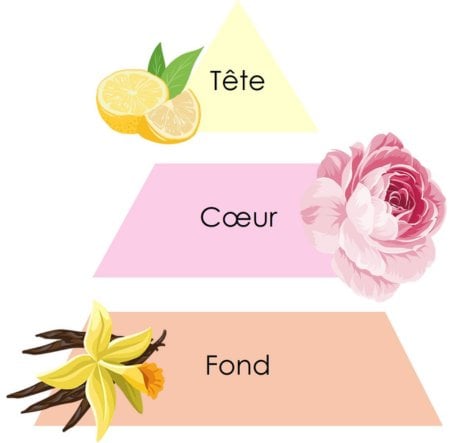
The olfactory pyramid corresponds to the architecture of a perfume; it is a representation of its structure describing the different notes, which reveal themselves in successive layers to our nose.
Represented as a triangle divided into three parts, these different “strata” refer to the longevity of the ingredients present: the base gathers the perfume’s base notes, the center the heart notes, and the tip the top notes.
The subtlety and longevity of the perfume, which then develops continuously and gradually, depend on the harmonious balance of these three categories of notes.
It is these three top, heart, and base notes that define a perfume: more or less concentrated, more or less intense, they make it come alive differently throughout the day and give it a soul and dimension. When a perfume has well-balanced top, heart, and base notes, it is said to be “faceted” and to have depth.
Top, heart, and base notes in the olfactory pyramid: what are the differences?
The top note: a fleeting first impression
Top notes, the first ones we smell, most often correspond to lighter and more volatile raw materials. The top of the olfactory pyramid therefore corresponds to the first impression given by a fragrance, which will determine whether or not we want to discover the other notes. An all-important opening, also described as the “smile” of the perfume.
Intensity of the top note: Lively, fresh, light, and ephemeral, it reveals itself immediately and directly. This is often referred to as the “flight” of the perfume.
Longevity of the top note: fleeting; it can be powerful but fades quickly (after about 5 to 15 minutes).
Ingredients most represented in top notes: these frequently include citrus (lemon, mandarin, bergamot), aromatic herbs (lavender, verbena, mint…), and certain lighter fruits (peach, mango, pineapple) or flowers.
The heart note: the perfume's character
A link between the top notes and the base notes of the perfume, the heart notes embody the personality of your fragrance and infuse it with its character. They are also called the “curves” or the “roundness” of the perfume.
Intensity of the heart note: less intense than the top note, it reveals itself gradually.
Longevity of the heart note: “heavier” than the top note, the heart note appears a few minutes to a few hours after diffusion. After lighting a candle or a diffuser, it is only fully revealed after 20 to 30 minutes, once the top note has evaporated, lasting for about 4 hours.
Ingredients most represented in the heart note: These often include raw materials such as flowers and fruits, but also spices (cinnamon, cardamom, ginger, etc.) and marine accords.
The base note: the memory of the perfume
Finally, the base notes constitute the essence of the perfume, its olfactory signature, its “soul.” They leave a lasting impression in the memory. The base note allows you to determine in the long term whether or not you like a perfume.
When a perfume is well-constructed, its different notes harmonize with each other, making it possible to smell the base notes from the very first seconds. In perfumer jargon, it is said that “the flight prepares for its conclusion.”
Intensity of the base note: the most intense and persistent of the olfactory pyramid, it is the last to manifest.
Longevity of the base note: tenacious, it is a lasting note that often helps fix the accords. It evaporates slowly and allows the perfume to last over time. The base note is still perceptible after several hours, or even days on certain surfaces (textiles, etc.).
Ingredients most represented in the base note: base notes often include woody essences (patchouli, cedar, sandalwood, vetiver), “animal” notes (amber, leather), resins/balsamic notes, as well as more gourmand notes (notably vanilla, tonka bean, almond).
Understanding the different notes of a fragrance helps one grasp its complexity. You must take your time when choosing a perfume to smell each of them, letting it evolve over time and space so it can gradually reveal all its secrets.
Let yourself be surprised: a top note that seems unappealing to you might also hide a splendid heart note and a base note worthy of a masterpiece!
To choose your next home fragrance, we invite you to discover here the different olfactory families that characterize the world of Estéban perfume.