














History and Symbolism of the Fan
More than just an accessory to finish an outfit or a utilitarian object used to cool off with a flick of the wrist, the fan is a mysterious object, highly symbolic and with numerous uses, some of which are millennia old. Estéban takes you on a journey to discover this object rich in culture and history…
The fan, an instrument of power and protection
The first traces of the fan can be found in Ancient Egypt. At that time, the first refined fans were reserved for the ruling elite. While the use of palm fronds and other large-leaf branches was certainly very common for fanning oneself in these arid regions, the use of feather fans (notably ostrich) was the prerogative of the pharaohs. The feather, coming from a being that forms the link between heaven and earth, capable of rising high into the air, symbolized the protection that the sovereign guaranteed to his people (likely one of the origins of the expression "to take under one's wing"). Kings of many civilizations have indeed made feathers a royal attribute, whether in the form of crowns, scepters... or fans. For the Egyptians, the choice of ostrich feathers also had a particular meaning. The latter, due to its unique shape (equal width on either side of the central axis – which is not the case for other feathers) is an attribute of the goddess Maat, goddess of justice, truth, and rectitude. An important symbolism for the Pharaoh, who must make the right decisions regarding the affairs of the Kingdom.
The fan in religious rituals
But the history of power – particularly religious power – also grants the fan another function, one that is… esoteric, to say the least. Greek sources from ancient times indeed evoke the recurring problem of flies invading the altars dedicated to the gods, where food offerings were regularly placed. Then called an esmouchoir (fly-swatter), the fan made it possible to protect food from flies, which were significant vectors of epidemics. Later, the adoption of the flabellum (a large fan of feathers or leaves carried on a long handle) by the Catholic Church continued this tradition, nourished by the belief that moving air helped to drive away evil spirits (in the Christian imagination, flies are associated with disease, sin, and the devil). This is why flabella were regularly found near altars, intended to protect the chalices from malevolent spirits.
The fan in Asia
In Asia, too, flies were not held in high regard: in the Kojiki, an ancient text that brings together various Japanese mythological narratives, the sound of evil spirits is compared to that of a swarm of flies. The idea of a fan as an instrument of "purification" was so deeply rooted that at the Imperial Court of Japan, it was the Buddhist monks who were assigned to their manufacture. The fans designed in this way not only allowed for the warding off of malevolent breaths but also for "absorbing" sacred texts (previously printed on the fan's panels) by fanning oneself with them!
From its origin, the fan has been intimately linked to the sacred realm. The first "secular" uses of the fan known to Europe owe their existence to the Silk Road, which allowed for the importation of objects and products from the Asian world. For, in the collective imagination, the fan is a Chinese or Japanese object. And rightly so...
The evolution of the fan over time
Fixed and brisé fans
Fans were initially fixed (these are known as "screen" fans). Made of feathers, wood, or plants woven together, these fans attached to a handle were very useful for cooling off but not always very practical, both in their format and in their handling (the largest formats required a bearer – an oh-so-honorific function in Ancient Egypt).
These fans were gradually replaced by "brisé" fans, more convenient thanks to their ability to fold. Composed of thin, independent slats of wood or ivory connected together by a ribbon, traces of them can be found in Europe as early as the Roman Empire, but also in Asia as early as the 7th century BC. Beyond its ventilation and ceremonial functions, it took on another use once its wooden slats were replaced by metal: that of a rallying sign on the battlefield or a defensive weapon during sword fights, used by the samurai class of feudal Japan.
The invention of the Japanese sensu
This fan model endured until the invention of the Japanese sensu (or Ogi) in the 7th century AD. A discovery that, according to some accounts of the time, the Chinese regretted not being able to claim as their own, so practical and aesthetic did the invention prove to be. And indeed, the first folding fans arrived in China relatively late, during the Song Dynasty (960-1279).
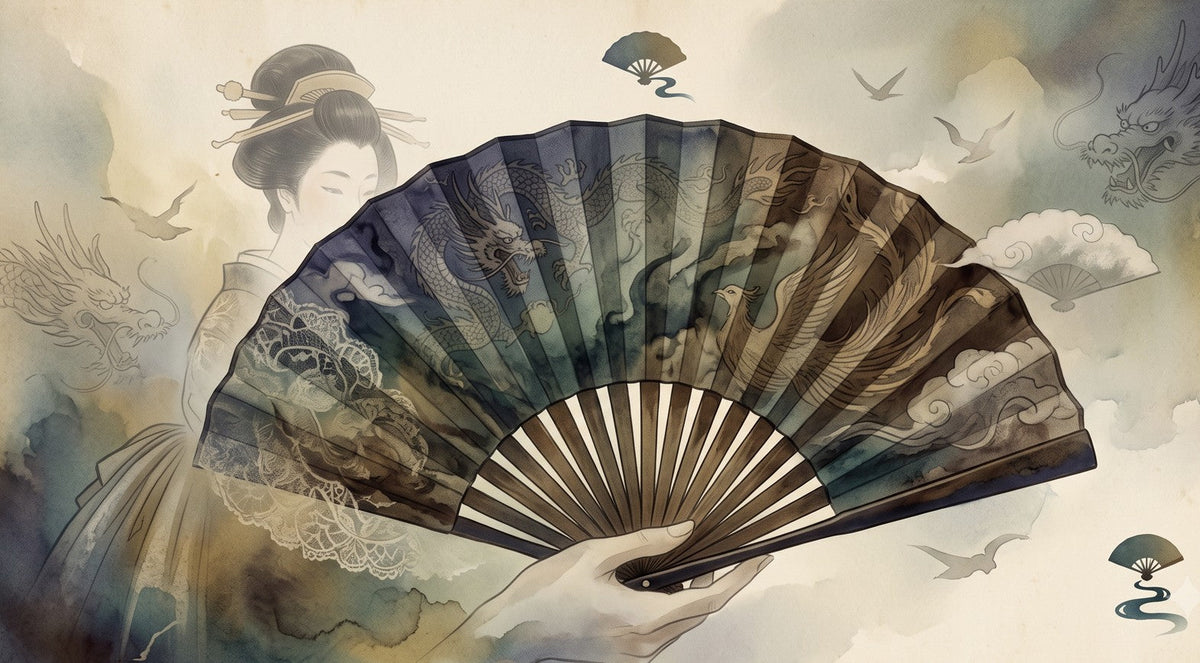
Inspired by bat wings, the Japanese folding fan refers to a set of bamboo sticks or wooden slats riveted together at one end and connected by a sheet of paper folded like an accordion. Since the practice of folding is a notable prerogative of Japanese culture (where origami embodies an entire philosophy), it is not surprising to learn that it was in Japan that the famous "folding" fan that we still use today was born.
The sophistication of Japanese fans
As in many other fields, Japan appreciates sophistication. Folding fans therefore quickly took on the stature of almost a work of art. The wooden structures, often lacquered, were made of fragrant woods such as sandalwood or Hinoki wood (also called "false cypress"), offering a delicate scent to the bearer of the fan and to their interlocutor. The central piece of the fan, for its part, was made of washi paper (a particularly resistant paper made from mulberry fibers) or silk, depending on the uses and types of fans. For the sensu in Japan was much more than an everyday accessory...
The fan, a true art of living
The fan in daily Japanese life
Until the modern era, the sensu was present in every aspect of Japanese life. An accessory for both men and women, it has hardly any Western equivalent, so multiple are its symbols and functionalities.
In a culture where giving objects directly by hand was long considered impolite, the fan notably allowed for creating a link between individuals, establishing a sort of discreet dialogue between two people. Folded, it allowed for pointing at something without having to point with a finger; unfolded, it served as an improvised tray to hand an object to someone. By its extended shape (it widens as it unfolds), the fan could also evoke spiritual progression, openness, and personal growth. Offering a fan thus allowed for the transmission of wishes for prosperity ("may your life, your riches unfold like this fan"). A tool of courtesy and propriety, the fan also allowed for politely hiding a laugh or acting as a protective barrier during greetings or the offering of condolences (the fan was then pulled from the kimono and placed between the two interlocutors). Even today in Japan, offering a fan is a gesture that is appreciated, without having to write a small message to the recipient beforehand as was done previously, directly affixed to the paper that composes it. Thus close to the eyes of its owner, the message takes on a particular emphasis. This use of the fan as a writing medium appears very regularly in the stories and romantic tales of Japanese culture, contributing to giving the fan a role as a most poetic messenger and ambassador.
The fan in Japanese arts
But how can one speak of the importance of the fan in Japan without mentioning its centuries-old use in dance (notably by geishas), theater (Noh or Kabuki), or martial arts? There was, moreover, a specific name for a fan to describe the accessory with which geishas performed the famous fan dance (a sequence of poses evoking a story, borrowing from the codes of theater): the Mai-ōgi (most often made of silk and decorated with splendid motifs). In traditional theater, precisely, each actor was equipped with a fan that evoked the character of the personage and gave emphasis to gestures. Known for its spareness, this form of theater offered the fan multiple figurations: that of an oar, a sword, a knife, or a tray. Sometimes, too, it allowed for symbolizing snow, rain, or the sun. Finally, in certain martial arts, the fan could be integrated into combat techniques used to disarm an opponent.
We can thus see that, far from being a gadget or a sartorial detail, the fan is an object rich in meaning and symbols, as complex and refined as its composition is simple and rudimentary.
Official licensed Paris 2024 fan by Estéban
A must-have to take everywhere this summer! At the stadium, outdoors, or on public transport for a breath of citrus freshness throughout the day. Fall for this beautiful scented Citronella & Mint fan, a beautiful Made in France scented object made of solid wood that can be re-scented endlessly with the Citronella & Mint home fragrance spray.