




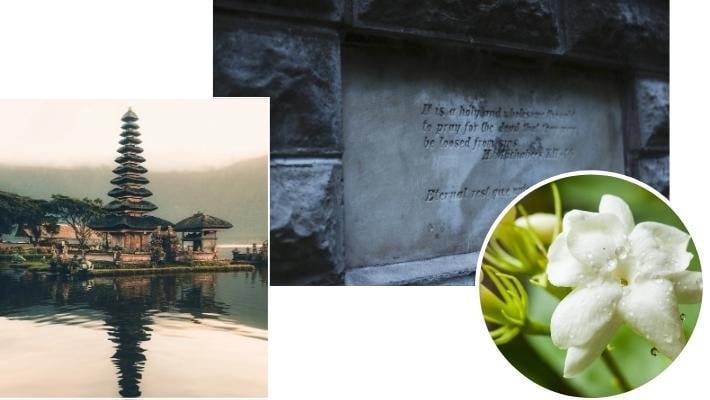
Scented Story No. 2
To continue this series on the fragrant tales of the world, after the tropical atmosphere of Polynesia, we set course for the enchanting landscapes of Indonesia.
"The Magic Turban, the Enchanted Dagger, and the Miraculous Script" - A Javanese Tale
In a distant land lived an old sage named Ayi Saka. Driven by a need to distance himself from men to meditate on the mystery of life in the silence and solitude of the forest, he stood motionless in the heart of the jungle for 7 days and 7 nights. It was there that his heart, filled with peace, was penetrated by a magical power, one that gathers the flowers of the forest. Upon returning from his seclusion, the sage summoned his two servants, Sembada and Doro, and told them: "While I was waiting in the silence of the forest, the east wind brought me the scent of jasmine and, with it, a strange dream of a wonderful island where a poor and uneducated people lived, ruled by a hideous ogre king named Sang Prabu. I heard an unknown voice calling for help, so I ask you to accompany me on this distant journey." Sembada and Doro agreed eagerly before asking the sage which direction to take. Ayi Saka smiled and replied, "The scent of jasmine found me, so it will be the one to decide." With these words, the sage plucked a jasmine flower, dropped it to the ground, and held out his hands. The flower began to grow until it could shelter the three men and flew away with them like a flying carpet. They flew over many oceans and continents until the long white beard of Ayi Saka, which was floating in the wind, caught on the summit of a mountain.
"We have arrived," the sage deduced. "Stay on your guard; we are on the territory of the demons tasked with guarding the access to the kingdom of Sang Prabu," he added. "Sembada and I will penetrate the heart of the country, but you, my faithful Doro, will stay here with this magic dagger, which will allow you to prevent the demons from flying to the rescue of the Ogre-King. Remember that spirits know how to change their appearance, so do not hand this dagger over to anyone but me, for the demons do not have the power to impersonate me." Doro promised, and the sage, accompanied by Sembada, descended the mountain. On the way, they did not meet a living soul until they finally stumbled, after several hours of walking, upon an old man weaving a basket. The sage asked him about his people, and the old man replied, "Our kingdom is cursed: every morning, our viceroy brings our sovereign a handsome young man who is devoured that very day. All the mothers in this land fear the dawn, and fathers clench their fists in helplessness when the sun appears in the firmament. The people are deserting the kingdom or hiding in the forest. Tomorrow, the viceroy will present his own son to Sang Prabu because all the other inhabitants of the country have fled."
The sage asked the old man to take him to the viceroy, which he did immediately. Once before the executor of Sang Prabu's will, the sage said: "News of the misfortune befalling your country has reached me; tomorrow, send me to the King in place of your son, and I promise to rid your kingdom of this cruel ogre." "Your gaunt body and white hair will never interest the King; Sang Prabu refuses to eat old men." Ayi Saka smiled, touched his own forehead, and, immediately, a young man stood before the viceroy. Only the long white beard continued to adorn his face. The viceroy, amazed by this display of magic, promised to grant all his desires if he succeeded in ridding the country of the tyrant. To which the sage replied, "I want a plot of land that can be covered by my turban." Surprised but delighted by such a modest wish, the viceroy swore it.
The next day, when day broke, Ayi Saka was led to the king. Sang Prabu, delighted by this new offering, pulled the young man closer to his throne by his white beard. "What is this beard, my boy? Is it edible?" "Taste, my Lord; you have never eaten anything better in your life," replied the sage. The King took Ayi's beard in his mouth and began to swallow it with ferocity. Suddenly, the beard began to grow as if it were endless. It caught fire inside the ogre's body, and the latter died in the flames, leaving only a small pile of ashes. The whole kingdom was in jubilation. The viceroy summoned Ayi Saka to the throne room and asked him to take, as promised, all the land that his turban could cover. The sage, with a smile on his lips, asked Sembada to unroll the fabric that protected his head. Even though the servant hurried, the fabric did not diminish, quickly covering the jungle and the mountains, the rivers and the lakes, the entire country. Thus, Ayi Saka became the lord of this great kingdom, which he administered with wisdom and benevolence. One day, he remembered his companion Doro, who had remained in the mountains. He asked Sembada to find his friend and ask him to found a great city at the foot of the mountain that would guard the access to our kingdom. He also asked him to bring back the magic dagger.
After endless wanderings, Sembada found Doro, exhausted by his constant battles with the demons. He relayed the sage's message and asked him to hand over the dagger, which Doro, keeping his master's instructions in mind, refused to do. Driven by their loyalty, the two friends engaged in a fight to the death to fulfill the task their venerated master had entrusted to them. At the end of this long and fierce battle, they both collapsed from the very same blow.
Not seeing Sembada return, Ayi Saka set out in search of him and discovered the lifeless bodies of his servants at the foot of the demon mountain. He then remembered with regret the task he had entrusted to Doro and the order given to Sembada, understanding that they had all paid with their lives for the loyalty and love they bore him. He then picked up the magic dagger and carved a magical inscription into the rock, an eternal souvenir of his two friends:
"Ha na tsa ra ka - "Faithful servants
Da ta sa wa la - Fought together.
Pa da ia ya nya - Both of equal strength
Ma ga ba ta nga" - Became inanimate corpses."
As soon as the last letter was carved, a miracle occurred. Doro and Sembada emerged from their death-like sleep. With tears in his eyes, the sage took them in his arms and said, "May this magic inscription become the writing of the people of this country forever, in memory of the nobility of your souls." And so it was.
If one day the wind from the Orient, scented with jasmine, brings you mysterious words: "Ha na tsa ra ka," know that on a wonderful island lost in the ocean, little Javanese girls and boys are reciting their alphabet on school benches."
Source:
"The Magic Turban, the Enchanted Dagger, and the Miraculous Script" is a tale taken from the collection Les plus belles légendes de fleurs (1992), itself part of the collection of world tales and legends gathered by Gründ editions. The original text is by Vratislav St’ovicek, and the French adaptation is by Dagmar Doppia. The work is conceived as a gathering of flowers that tell each other their stories one by one. "The Magic Turban, the Enchanted Dagger, and the Miraculous Script" is the story told by the Jasmine.